
Blog
LEC and Double-Ended - Innovations in Cannabis Illumination
What actually is LEC lighting?
For decades, conventional HPS and MH lights have been the standard for indoor growing. In the meantime, some technical innovations have been added and some manufacturers are developing so-called Light Emitting Ceramic Lights. These offer some advantages over traditional lighting. LECs run cooler, provide full light transmission, use fewer watts, help save costs and are more durable. They are perfect for smaller grow rooms and grow tents because they generate little heat. In the commercial sector, they are interesting because of their long life and reliable spectral effect.
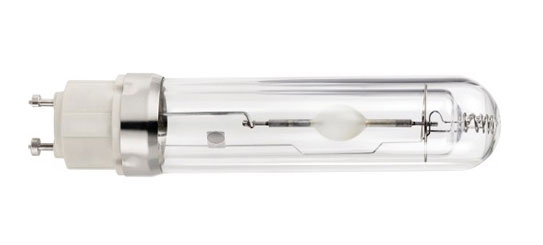
LECs work similarly to MH lamps, but instead of quartz they use a cramic arc tube, similar to an HPS lamp. Compared to traditional MH and HPS lamps, LEC lamps produce a more natural color and produce more light per watt. LECs produce UV-B rays. However, they only pass through absolutely clean glass and only then are they effective. Therefore, the lamp should always be kept clean and regularly dusted. It is best to use sunglasses or special grow glasses to avoid damaging the eyes and, of course, never look directly into the lamp.
Sun has a CRI (light rendering index) of 100, LECs have a CRI between 80-96. HPS lamps (NDLs) have a CRI around 22 and MH lamps have a CRI of 65-70. LEC lamps are often referred to as CMH lamps or CDM lamps, they are the same technology.
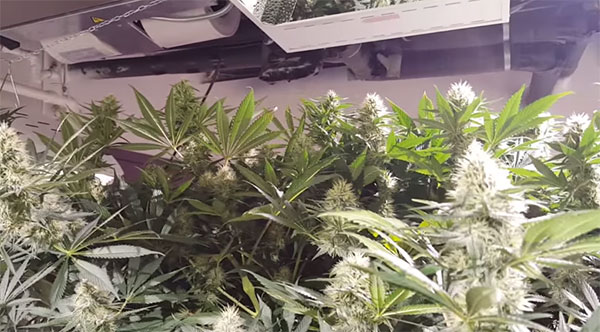
Plants growing under a 315W LEC
LECs produce a natural light spectrum, which means you can see the plants as they would naturally appear under sunlight. The light is not distorted purple (as with LEDs) or yellowish (as with HPS lamps). It is therefore easier to see problems and changes in the plants and is less noticeable should it ever shine out of the grow tent.
Many LECs like the Sun System LEC® 315 Watt already have a built-in ballast and can be operated immediately (plug and play). With HPS lamps (= NDL lamps), the ballast is usually external.
A 3100K LEC bulb provides the full light spectrum and can be used for both the growing phase and the flowering phase. It only needs to be replaced approximately every 2 years, rather than 1x per year, unlike traditional NDL bulbs.
LEC bulbs cannot be operated with normal digital ballasts, but only with those specifically designed for this type of bulb.
Ceramic discharge metal halides produce intense light at about half the watts of conventional MH or HPS bulbs. Thus, the same bulbous area can be illuminated with substantially fewer watts. Because of the lower heat generation, the light can be brought closer to the plants, resulting in faster cannabis plant development and greater yields.
Double-Ended HPS Lighting - When your plants are growing faster than you can make room in the grow room.
Another new development in cannabis lighting are the new double-ended lighting systems. This technology puts indoor cultivation on a new path to better and higher yields also in terms of quality. Double-ended light sources have a much longer life (about 10,000 hours) than conventional NDL light sources and still retain about 90% of the original light intensity until the end of their life.
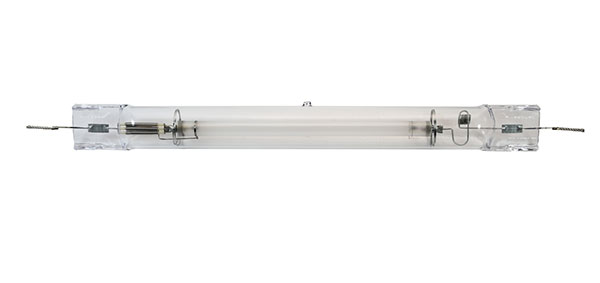
Double-ended lamps are filled with nitrogen gas. This allows the bulb to operate at higher temperatures, which increases efficiency. Double-ended HPS lamps have "2 ends". The symmetry of the bulb allows for easier propagation of light. Light intensity in this context is often expressed in mocromoles. Each illumination emits a certain number of photons per second. Double-ended lighting can emit 2000 micromoles of photons per second, whereas a T5 fluorescent emits 50 micromoles of photons per second. The measurement of micromoles provides the opportunity to understand what crops need in relation to light requirements of different varieties and stages of plant development.
Double-ended illuminators can be used in the flowering phase and in the growing phase. During the flowering phase, they outperform all other currently available illuminants. They have 10% more light intensity than conventional NDL illuminants and emit more UV and IR light. In a nutshell: Double-ended light sources get more out, produce higher yields than ordinary HPS lamps. Double-ended light sources still have 90% of their efficiency after 10,000 hours of operation.
The technology has been used by commercial growers for about 10 years.
Is the higher price justified?
The answer is a resounding yes. Double-ended lighting improves the quality and quantity of light usable by plants, thereby increasing the production of terpenes and cannabinoids, as well as yield.
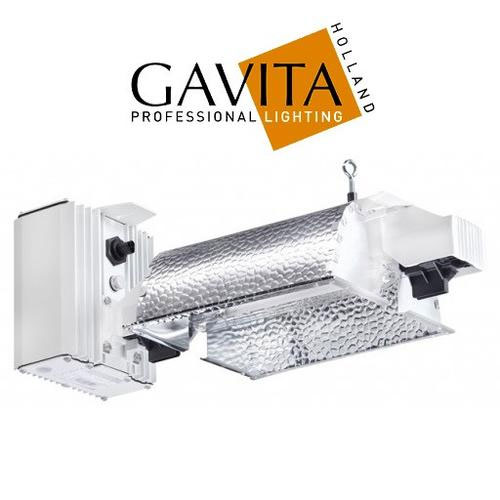
At this point we can especially recommend the GAVITA PRO 6/750E Double Ended FLEX recommend the GAVITA PRO 6/750E. It is characterized by reliability, good workmanship and can be used immediately after unpacking without long wiring or technical knowledge (plug & play).