

Blog
Planters for cannabis plants

There are different planters that are used and suitable for growing cannabis. They can be divided into three categories: Grow bags (e.g. Smart Pots or Texpots), plastic plant pots or grow beds or raised beds, which are mainly used for outdoor growing.
The most important thing is that planters have sufficient drainage holes at the bottom and possibly at the sides so that excess water can drain away quickly and the planter protects the roots from light. Transparent and translucent pots are therefore unsuitable.
Texpots or Grow Bags
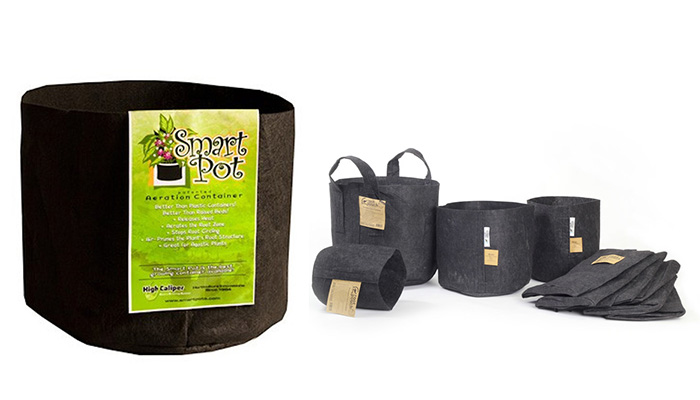
Texpots or grow bags made of textile, breathable fabric are very popular with many growers. They are cheap, you can store or transport them easily to save space and they are robust and durable. Fabric bags like the Smart Pots can be reused. After a grow, they are simply emptied, rinsed with water and then soaked in soapy water overnight. The next day, rinse thoroughly with water and they are ready to use again. Plant bags made of breathable fabric also ensure good ventilation of the root zone and this can also be seen in the vigorous growth of the cannabis plants.
Texpots are an excellent option for outdoor growing if the existing soil is not suitable for cannabis cultivation, if you want to move cannabis plants during the grow and if you want to fill huge plant pots. At the latest from 100L, fabric pots are the best, simplest and cheapest solution for outdoor growing. But you can also achieve excellent results with the small tissue pots. They can be used just as well for indoor growing and are suitable for cultivation on soil as well as for hydroponic cultivation.
White Texpots are usually intended for outdoor cultivation and reflect sunlight due to their white colour. This way, the containers do not heat up so easily. Dark or black Texpots are intended for indoor cultivation. Of course, white pots can also be used indoors and vice versa. Grow bags made of textile fabric need to be watered more often because water can evaporate faster in them. In general, Texpots should therefore be twice as big as the plastic pots you would use.
- More oxygen for the roots
- Protects plants from root-bound
- Overwatering is hardly possible
- Dries out faster than normal plastic plant pots
- Indoor growers need trivets or a plant tray to catch water run-off.
Standard plastic plant pots
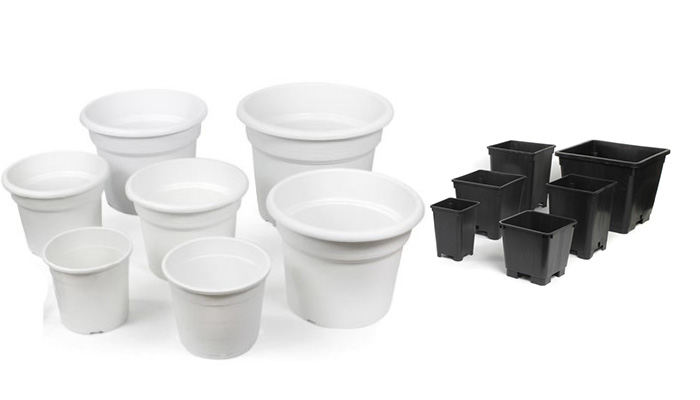
The ordinary plastic plant pots are the most commonly used. They have drainage holes at the bottom and are cheap to buy. The sides are usually somewhat flexible and these planters are usually black or white. Plastic planters come in round and square shapes. It is a matter of taste and you can argue about whether round or square are better: the square pots are more space-saving and are used the most. I like the round pots better because I think plants like it better round. But there is no scientific evidence for that at the moment.
In summer and for outdoor growing, plastic planters can easily overheat and the roots are damaged. Plastic pots are generally more prone to overwatering and waterlogging. When growing indoors, coasters or a grow tray or grow table must be used to catch and drain away excess run-off water from the pots. Plant trays and grow tables are not only used for hydroponic cultivation, but are also an extremely easy and clean thing when growing on soil, when it comes to getting the excess water out of the grow box quickly and without much effort.
Air Pots
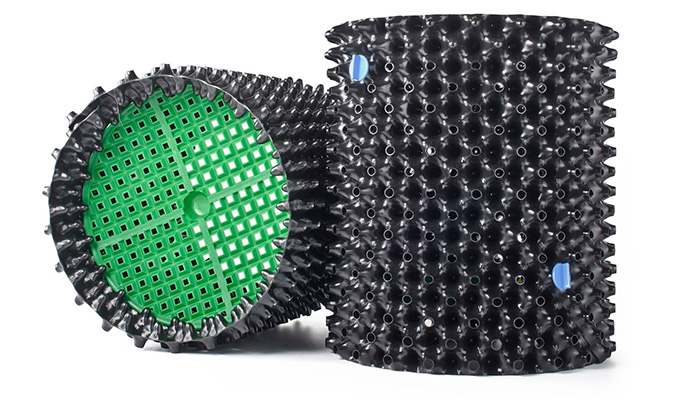
Air Pots provide excellent oxygen to the root and allow plants to grow abundantly and quickly. They help protect the plants from root-bound and overwatering. Similar to Texpots, they need to be watered more often because water can evaporate more quickly. Air-Pots can be used over and over again and can be easily disassembled for repotting, making repotting simple and stress-free for the plants.
- Good aeration of the root zone
- More frequent watering necessary
- help prevent root-bound
- faster growth of the plants
Woodee Pots / Fibre Plant Pots
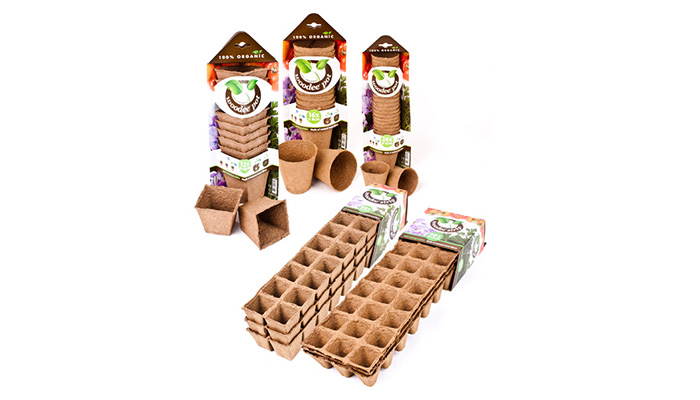
Plant pots made from plant fibres, such as the Woodeepots, are popular with many growers. They are compostable and made from 100% natural materials. Woodee pots are usually used for seedlings, young plants or cuttings. They are cheap to buy and easy to handle. Seedlings or cuttings can be transferred directly with these pots to the next larger planter. Woodee pots decompose into humus over time and even enrich the soil they are in.
- release excess water quickly, thus less risk of waterlogging
- Cheap to buy
- No stress for the plants when repotting
Coasters and planters
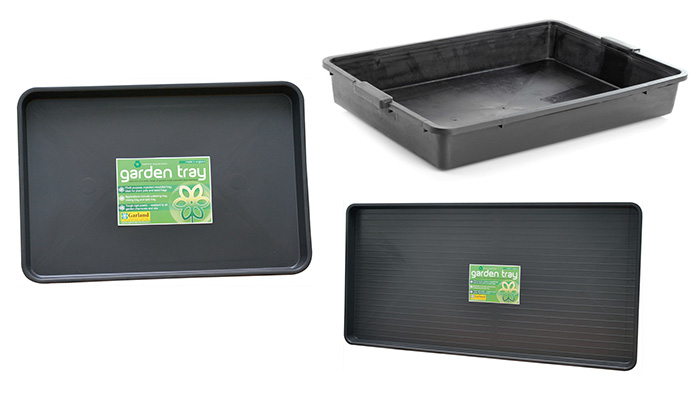
Coasters are placed underneath planters so that the water that runs off can be collected. This is especially necessary for indoor growing to avoid flooding in the grow box. Airpots and pots with holes on the sides need a larger saucer because water also runs off the sides. If you only have a few plants, it is still easy to work with trivets. The water that collects in these saucers after watering must be poured out immediately and must not remain standing for more than 20 minutes. The plants must not be left in it. This could kill or severely damage them because the roots will then very quickly begin to rot and suffocate. With several plants, this can be cumbersome and lengthy. Therefore, the use of a plant tray (with drainage), which is placed under all planters, is recommended and practical.
Plant trays come in all sorts of sizes and designs depending on the size of the plants and the size of the grow box. Trays or plant trays can collect the water of many plants and offer the advantage that the plants do not have to be moved and rearranged so often, which shows in better and faster growth. Instead of a drain, you can also work with a small water pump to pump the excess water out of the plant tray.
Planters for hydroponics
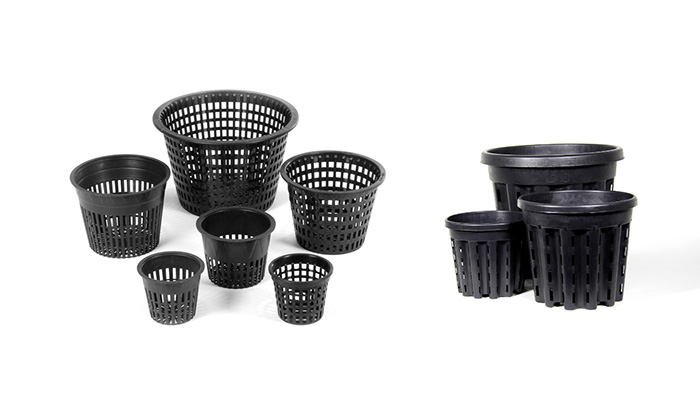
Planters for hydroponics have grid-like sides and bottoms, hence the name grid pot. They are made of plastic, are brown or black and available in a wide range of sizes. They are characterised by the fact that the water can quickly reach the roots through the grid-like side walls and also quickly run off again. They are used exclusively on growtables or plant trays and in conjunction with a hydroponic system/irrigation system (e.g. drip irrigation and ebb and flow).
Pot shape and size of the planters
As already mentioned, planters can be round or square, with square ones being more space-saving. They are either wider than deep or deeper than wide. Cannabis growers who grow indoors or in a greenhouse prefer planters that are deep enough. All the planters you can find in our shop have the right shape that is suitable for cannabis plants. You just have to choose the right size.
The size of the pot determines the amount of water and fertiliser that needs to be given. As a rule, when growing indoors, the size of the pot restricts the plant in its full growth. This is also desirable because a fully grown plant only has room in a few houses. Planters should be large enough to allow the plant to develop a sufficient root system. They should also not be larger than necessary, so that efficient use of the growing space is ensured.
The right pot size according to the age of the plant:
- 0-3 weeks old: root cubes, cutting cubes, small mini pot
- 2-6 weeks old: pots with a diameter of approx. 10cm
- 6-8 weeks old: 7.5L pot
- 2-3 months: 11L pot
- 3-8 months: 19L pot
- 6-18 months: 40L pot
Small plant pots
Small plant pots with 11L are ideal for plants with a height of 60-90cm at the beginning of flowering. Small pots are especially suitable for small plants. They are easy to move.
Large plant containers
Especially mother plants and outdoor plants grow in large planters. They grow much larger than normal indoor plants and stay in their container for a longer time. When growing on soil, containers of 19-190L are needed for this. For hydroponic cultivation, 19-40L pots are sufficient.
When it comes to determining the appropriate size of the plant container, you should consider how large your plant will and should become later. Larger plants need larger containers, while smaller plants thrive better in smaller planters.
Which planter to start with?
Always start with a small pot (0.25L). This gives the best results and prevents the small plants and roots from being overwatered. If you put a small plant in a pot that is too big, you must water it very carefully. Under no circumstances should the entire pot be drenched and watered abundantly while the plant is actually still too small for its pot. Only give a little water around the plant.
Important tips on the subject of planters:
- The temperature in the plant pot should not exceed 24° C. If the temperature rises higher, the roots may be damaged and the plant will take several weeks to recover.
- A 2-3cm layer of expanded clay also prevents the substrate from drying out too quickly when growing on soil.
- Avoid plant pots that are too big. Small plants in too large pots are not yet able to remove the large amount of water in the oversized pot, it remains in the pot too long until it dries out on its own and the roots get too little oxygen during this time and the plant literally drowns.
- Relatively large plants can also grow in smaller planters (11L). However, they then need to be watered much more frequently and problems can occur more easily.
In very large containers, indoor plants can also develop a very large root system and it is possible for an active microbiological soil climate to develop, just as with organic grow outdoors. However, this requires some space. - When plants stay in their planter too long, even though they have already grown too tall, the roots start to grow in dense entwined circles along the edge of the pot. This is called root-bound. Root-bound can lead to more serious problems and makes the plant susceptible to all kinds of diseases. In addition, it is restricted in its growth and development, which will also show in the results. Therefore, always repot early enough, when the plant has filled the entire pot well but not excessively with roots.